Black Hole Artifacts – Surgical Clips

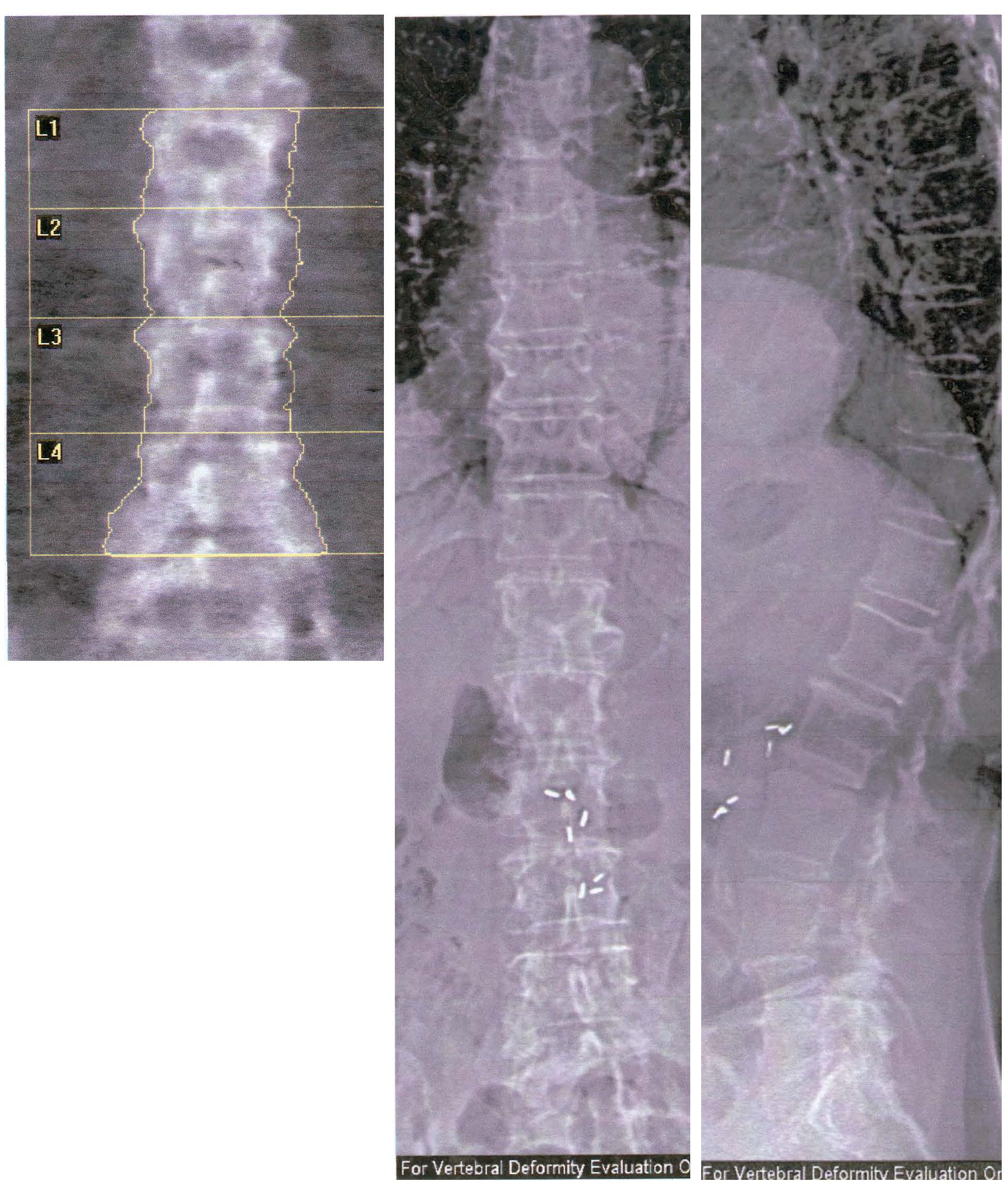
A dual-energy Hologic lumbar spine scan and the analagous VFA images which are single-energy. There are clips overlying L2 and L3.
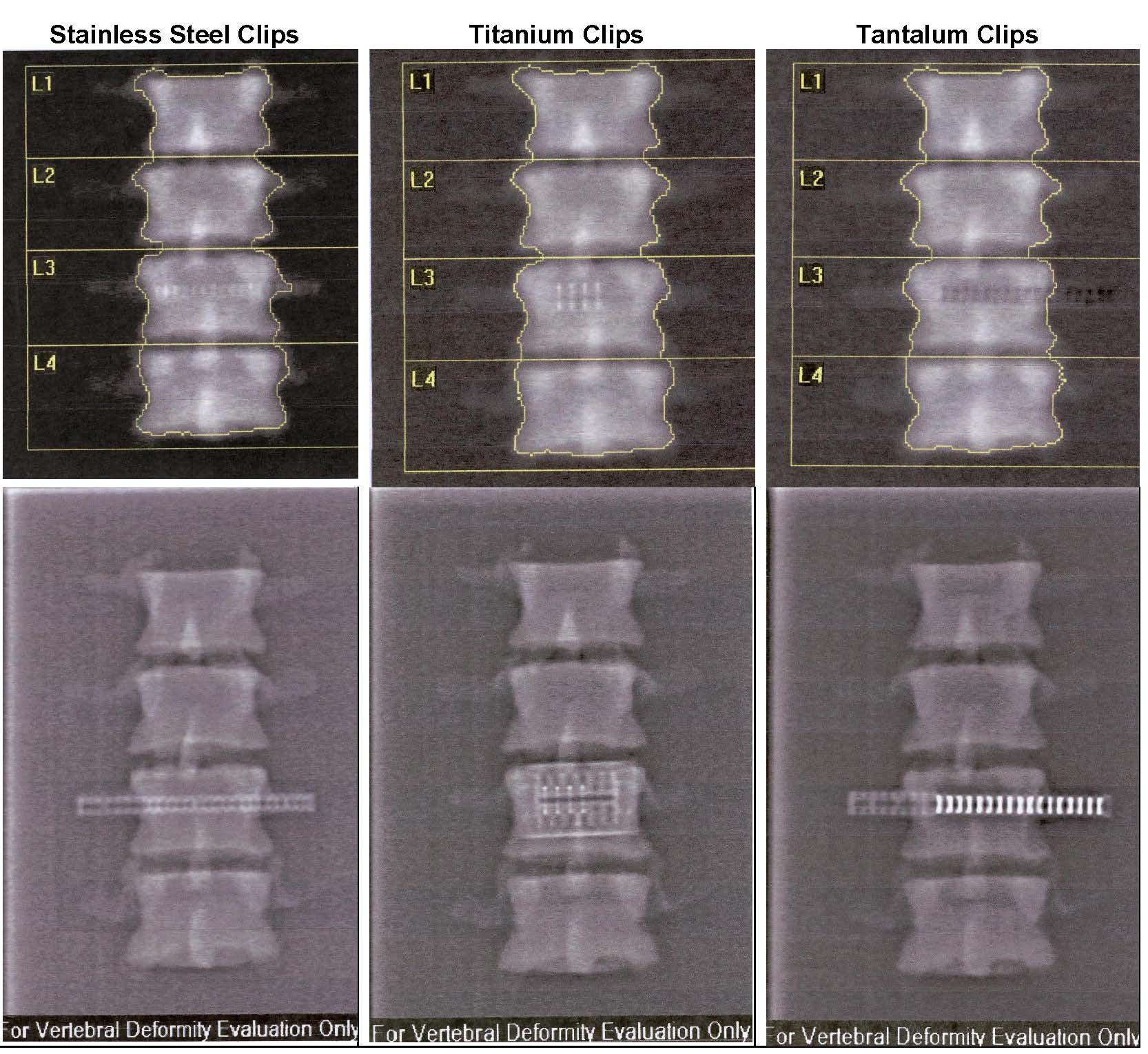
Various types of surgical clips viewed in both single and dual energy. Stainless steel and titanium clips are white in both single and dual energy. Tantalum clips are black in dual-energy and white in single energy.
The top panel of the top figure shows a Hologic dual-energy lumbar spine image. The middle and right panels show the VFA of the same patient. The VFA images are single energy in Hologic. On the VFA ,surgical clips overlying L2 and L3 can be seen which are white. On the lumbar spine DXA image (dual-energy), analogous black areas may be seen, which may not have been obvious on first evaluation of the image. It is likely that these are tantalum clips.
On a Hologic scanner, an image may be viewed in both single and dual energy. In this case, the clips are not as obvious in the dual-energy image because they are black, but are obvious in the single energy image. It is good practice to view an image in both dual and single energy to make sure that no artifacts are missed.
The bottom panel shows various types of clips over a spine phantom and the analogous single-energy image from the VFA. Notice that stainless steel and titanium clips are white in single and dual energy. However, the tantalum clips are black in the dual-energy image and white on the single-energy image. This is called a black hole artifact.
Black hole-type images show up blue in a GE Healthcare image.
Sarah L Morgan, MD, RD, CCD
The University of Alabama at Birmingham, Osteoporosis Prevention and Treatment Clinic and DXA Facility
• Morgan, S.L., et al., Black hole artifacts-a new potential pitfall for DXA accuracy? J Clin Densitom, 2008. 11(2): p. 266-75.
• Morgan, S.L., et al., More on the black hole: tantalum, stainless steel, titanium, and lead J Clin Densitom, 2007. 10(2): p. S202-S203
• Morgan, S.L., et al., Effect of very dense artifacts on Hologic and General Electric bone densitometry results. . Arch Osteoporos 2020. 15(1): p. 77.