Discordant Left-Right Hip Change in Osteoarthritis

The left and right femoral neck BMD differ from one another significantly. Although there is no established cut-point for when this discordance should be considered unusual, this difference is nearly 2 standard deviations.
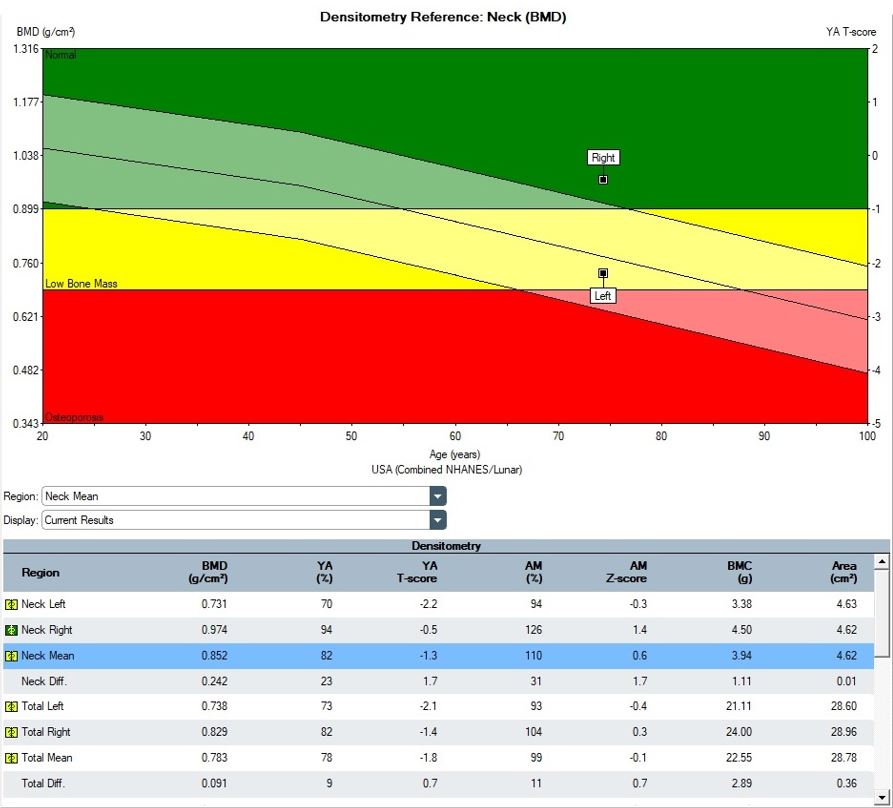
The right femur BMD is unreliable since it is based on abnormal anatomy resulting from osteoarthritis (OA). It should not be used for monitoring. Subsequently, the patient had right hip arthroplasty.
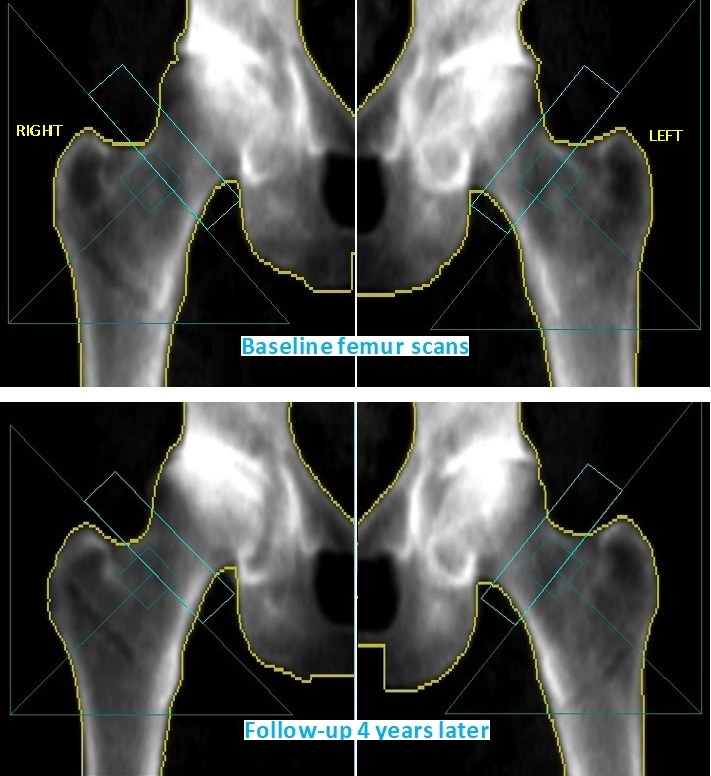
Between the baseline scan and follow-up, the right femoral neck BMD increased by more than 30% while the left neck remained stable. This same patient’s spine increased by 7% although it may have been somewhat falsely elevated due to sclerotic changes.
The patient stated that she is scheduled for a right hip replacement due to osteoarthritis. In OA, altered weight bearing stimulates abnormal bone formation at the inferomedial femoral neck. The cortex thickens in response to atypical mechanical stresses resulting in a “buttressing” effect (1). The morphology of one femur neck will differ from the other due to this adaptive phenomenon. Buttressing increases BMD measured at the neck. The unequal compressive load leads to local structural changes in femoral neck mineralization and resulting in physiologic discordance between the left and right sides especially related to weight bearing plays a key role (2).
Wendy Tolman-Andrews, BS, RT(BD), CBDT, UConn Health Radiology, Musculoskeletal Institute, Farmington, CT
1) Preidler KW, White LS, Tashkin J, McDaniel CO, Brossmann J, Andresen R, Sartoris D. Dual-energy X-ray absorptiometric densitometry in osteoarthritis of the hip. Influence of secondary bone remodeling of the femoral neck. Acta Radiol. 1997 Jul;38(4 Pt 1):539-42. doi: 10.1080/02841859709174383. PMID: 9240674. Dual-energy X-ray absorptiometric densitometry in osteoarthritis of the hip. Influence of secondary bone remodeling of the femoral neck – PubMed (nih.gov)
2) Lentle B, Hammond I, Worsley D, Colquhoun A, Grochowski C, Leggett J, Gill S. A Qualitative Examination of the Ward Region of Interest as Imaged on Dual-Energy X-ray Absorptiometry Examinations: The “Wandering Ward Sign”. J Clin Densitom. 2016 Oct;19(4):515-521. doi: 10.1016/j.jocd.2016.03.006. Epub 2016 Apr 18. PMID: 27102659. A Qualitative Examination of the Ward Region of Interest as Imaged on Dual-Energy X-ray Absorptiometry Examinations: The “Wandering Ward Sign” – PubMed (nih.gov)