
This panel shows the baseline and follow-up scan where the hip global region of interest is not the same as baseline

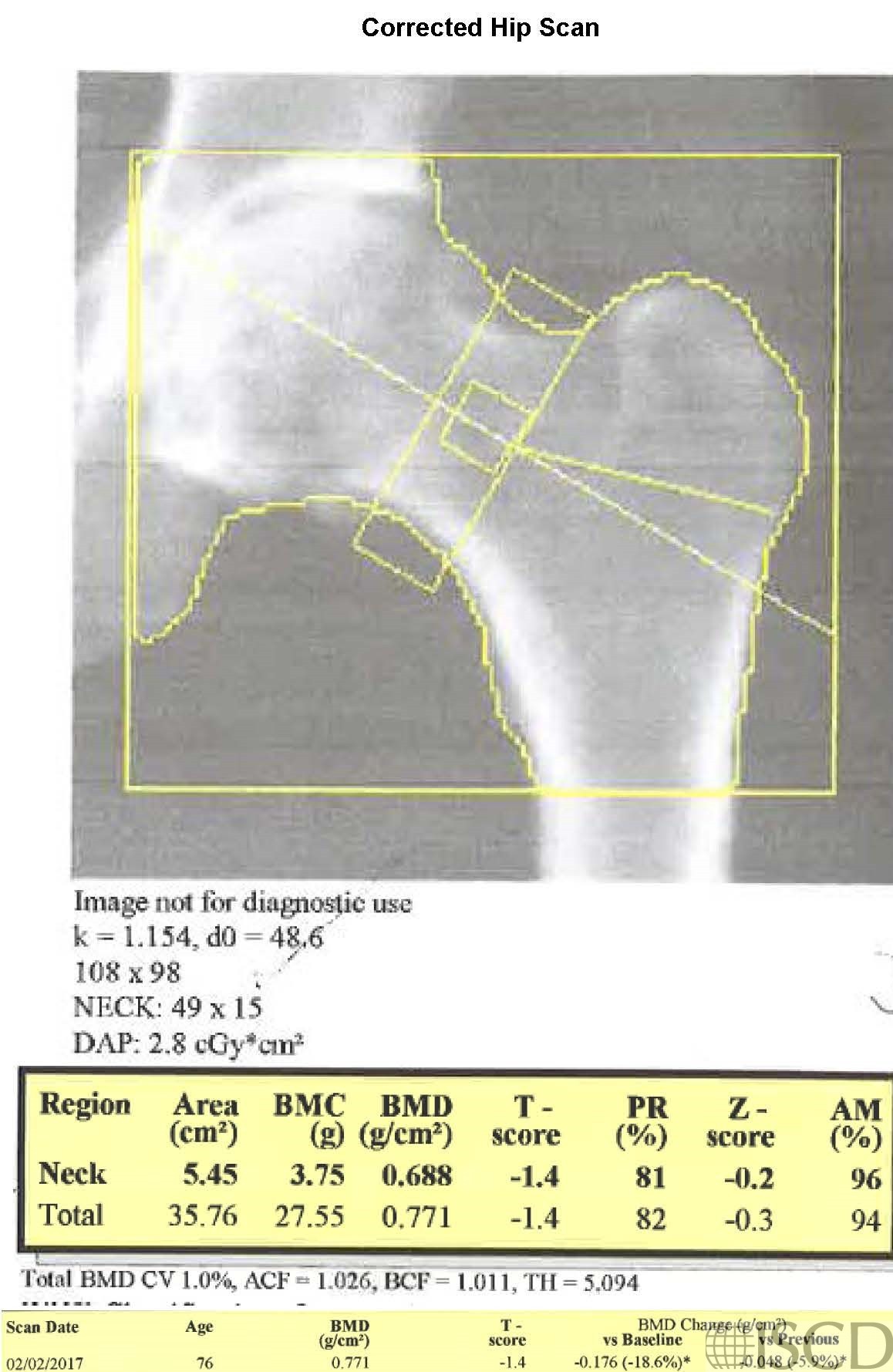
This panel shows the corrected follow-up scan, where the hip global region of interest size is now the same as baseline. Using the 95% confidence interval for the institution at the total hip, there is now a significant loss of bone density, using the 95% confidence intervals of the institution.
Case Description:
The size of the femoral neck box and the global hip region of interest should be the same from the baseline to a comparison scan in Hologic.
The upper left panel shows the baseline scan. The size of the global region of interest box is 108 x 98 pixels. The upper right image shows the follow-up scan, where the size of the follow-up global region of interest is 106 x 99 pixels, which is not the same as the baseline scan. The bottom image shows the corrected scan, where the global region of interest is the same size. In this case, with the incorrect size, there was not a significant change in hip bone mineral density. With the corrected scan, there is now a significant decrease, using the institution 95% confidence interval for the total hip
Credit:
Sarah L Morgan, MD, RD, CCD, The University of Alabama at Birmingham
References:
- Watts, N.B., Fundamentals and pitfalls of bone densitometry using dual-energy X-ray absorptiometry (DXA). Osteoporos Int, 2004. 15(11): p. 847-54.
- Choplin R.H., Lenchik L and S. Wuertzer, A practical approach to interpretation of Dual-Energy X-ray Absorptiometry (DXA) for assessment of bone density. . Curr Radiol Rep 2(48).
- Dasher, L.G., C.D. Newton, and L. Lenchik, Dual X-ray absorptiometry in today’s clinical practice. Radiol Clin North Am, 2010. 48(3): p. 541-60.
- Theodorou, D.J. and S.J. Theodorou, Dual-energy X-ray absorptiometry in clinical practice: application and interpretation of scans beyond the numbers. Clin Imaging, 2002. 26(1): p. 43-9.
- Mergler, S., et al., Lumbar spine and total-body dual-energy X-ray absorptiometry in children with severe neurological impairment and intellectual disability: a pilot study of artefacts and disrupting factors. Pediatr Radiol, 2012. 42(5): p. 574-83.
- Choi, J.S., The influence of soft tissue recognition errors on BMD value-A case report: Recipient of Young Investigator Award J Clin Densitom, 2012. 15(4): p. 483
- Fuleihan, G.E., et al., Reproducibility of DXA absorptiometry: a model for bone loss estimates. J Bone Miner Res, 1995. 10(7): p. 1004-14.
- Fuerst, T., et al., Quality Assurance in Bone Densitometry in Bone Densitometry and Osteoporosis K. Genant, G. Guglielmi, and M. Jergas, Editors. 1998, Springer Berlin.
- Hansen, K., et al., DXA Errors are Common and Likely Adversely Affect Clinical Care: DXA Quality Improvement is Needed. J Bone Miner Res 2016. 31((Suppl 1) Available at http://www.asbmr.org/ItineraryBuilder/Presentationaspx?pid=83c01c31-237b-4f07-81a5-1eeb2a7968aa&ptag=AuthorDetail&aid=00000000-0000-0000-0000-000000000000. ).
- Promma, S., et al., Errors in Patient Positioning for Bone Mineral Density Assessment by Dual x-ray Absorptiometry: Effect of Technologist Retraining. J Clin Densitom, 2018. 21(2): p. 252-259.
- Cetin, A., et al., Evaluation of the patient positioning during DXA measurements in daily clinical practice. Clin Rheumatol, 2008. 27(6): p. 713-5.
- Staron, R.B., et al., Computerized bone densitometric analysis: operator-dependent errors. Radiology, 1999. 211(2): p. 467-70.
- Baniak, N., S. Grzybowski, and W.P. Olszynski, Dual-energy x-ray absorptiometry scan autoanalysis vs manual analysis. J Clin Densitom, 2014. 17(1): p. 97-103.